
Same Boat, Different Specs?
If you’ve ever searched for a particular boat, but discovered that there’s conflicting specs for that same model? Unfortunately, there seems to be too many sellers/brokers who either don’t know the actual specs for that vessel - or they just don’t care 😏
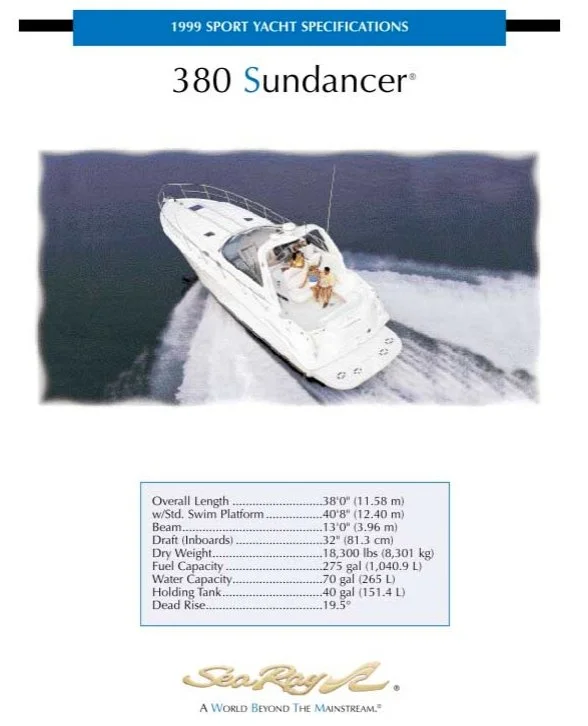
Above document is the Sea Ray factory spec sheet for the *2000* model year 380 Sundancer.
Looking at the factory spec sheets for the 1999-2002 380 Sundancer, one can see where some of the confusion might come into play. With 1999 being the first model year for that boat, Sea Ray lists the hull length at an even 38’, with the length overall (LOA) being 40’-8”, which includes the standard, factory installed swim platform.
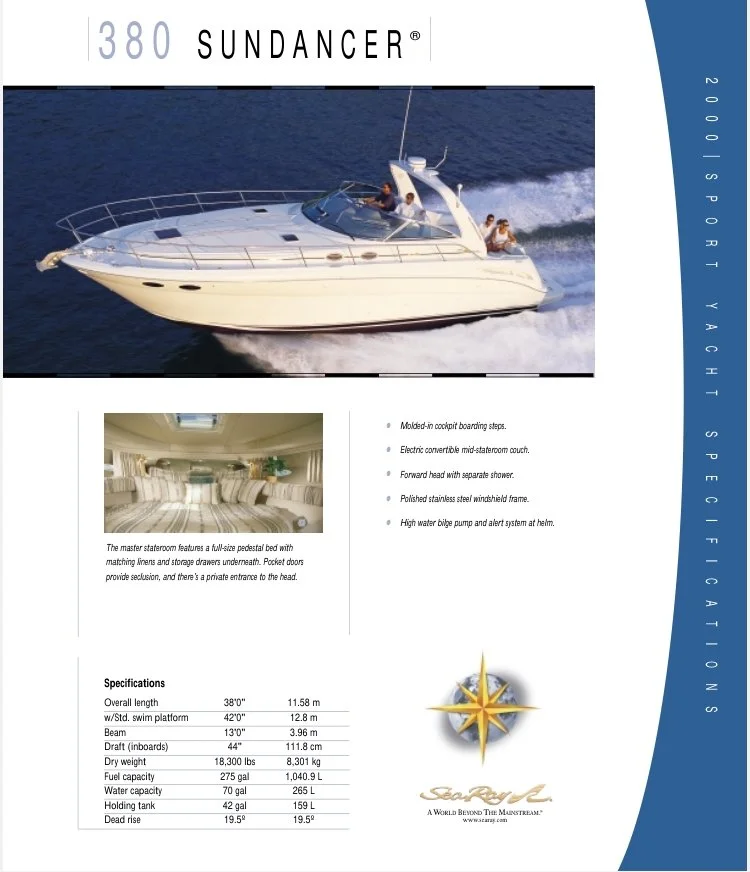
Above document is the Sea Ray factory spec sheet for the *2000* model year 380 Sundancer.
Moving into the 2nd year of production, the 2000 model year specs reflect identical dimensions, weights and tank capacities. Identical, except that the LOA has jumped up from 40’-8” to an even 42’. They also increased the stated Draft from 32” to 44” 🤔
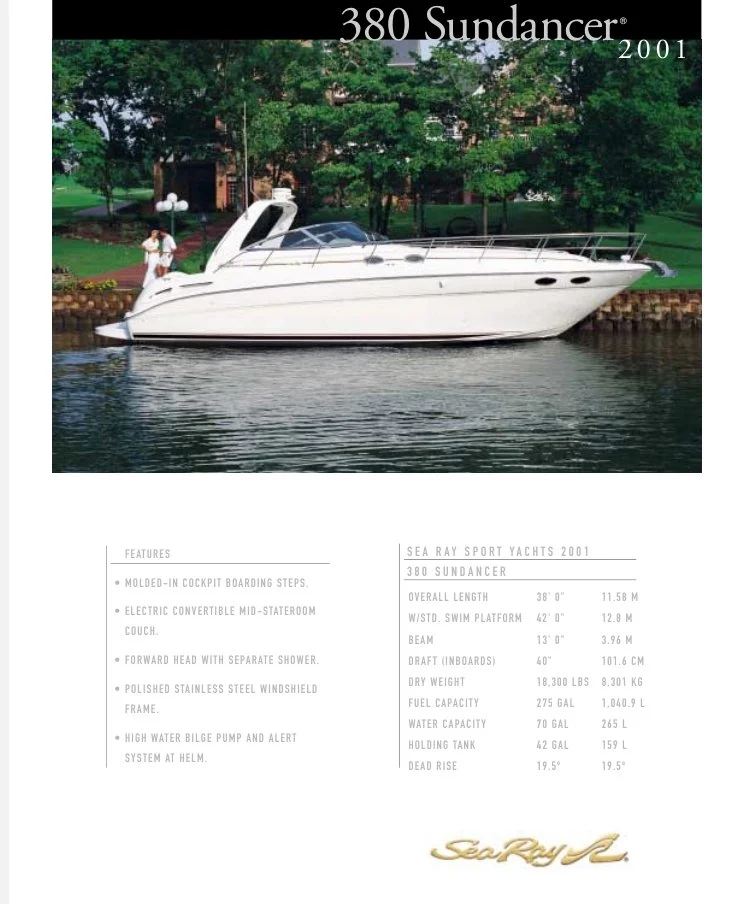
Above document is the Sea Ray factory spec sheet for the *2001* model year 380 Sundancer.
Looking at the 2001 spec sheet, the numbers have changed once again. This time, the Draft has been altered, suggesting a depth of 40”. So, over the course of three model years, the boat has either gotten heavier, then lighter - or perhaps the ‘test vessel’ went from freshwater to salt, to brackish when determining how deep in the water the boat actually sits 🤨
Why would the different water suggest varying depths? That’s because salt water provides greater buoyancy versus freshwater. And brackish water (freshwater saltwater mix, as one might find in some coastal locations) would be anywhere in between.
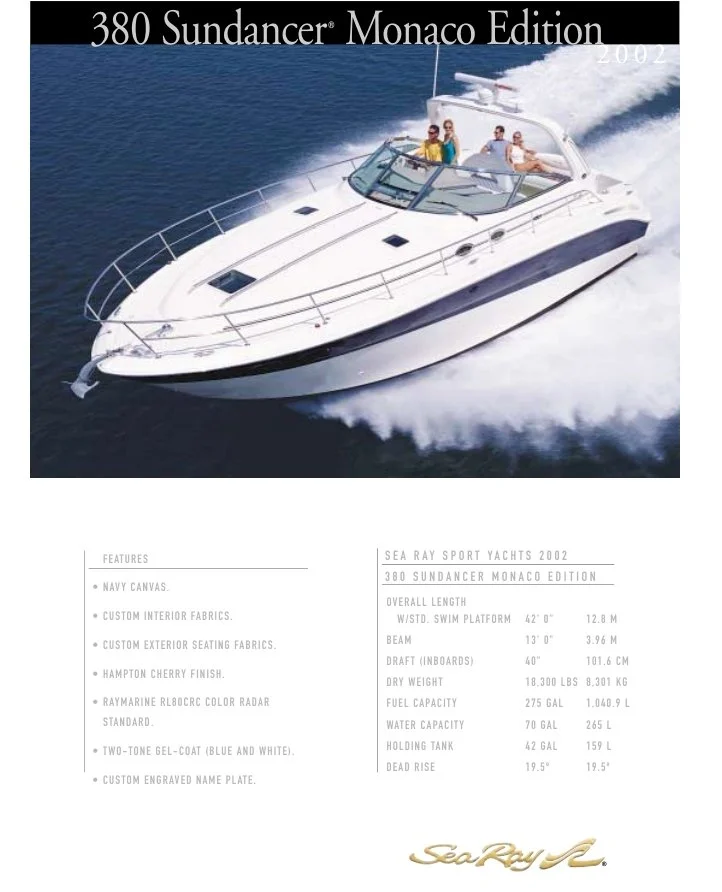
Above document is the Sea Ray factory spec sheet for the *2000* model year 380 Sundancer.
By the time the 2002 rolled around, it looks like the engineers, production workers and marketing folks were finally able to agree on all the specs for the boat!
All the numbers have remained consistent from the previous year - but even they can be potentially misleading for a couple of reasons. Given that these boats were produced with gas engines as the standard setup, they were also offered with optional diesel power. Twin diesel engines + a diesel generator would be significantly heavier than the gas option, making the boat sit deeper in the water. Deeper in the water results in a deeper draft.
Apart from the power setup, keep in mind that real world conditions, such as loading can greatly affect the attitude of how the boat sits in the water. Full fuel and/or water, even full fridges can add significant weight - not to mention the crew.
All that is something to keep in mind when considering these models. I believe that the only factual way to determine how any boat sits in the water would be to make a mark along the waterline when the boat is hauled out and use an old fashioned ruler to measure how far it is off the ground below.
Maybe the folks at Sea Ray could have done the same thing, as opposed to merely relying on engineering calculations 😉
